

I found the following article on “The eXile”, which is a Moscow based... uhh... "newspaper" (for want of a better word). The views expressed do not necessarily coincide with my own. But the staff at The eXile has done a helluva job! A must read, this article is!
This past year was a watershed both for Russia and for Russia's detractors alike. As they used to say after 9/11, "everything's changed." Although not exactly how the West imagined it.
For the first time since Mikhail Gorbachev launched his doomed Perestroika reforms, Russia returned to its rightful place as the White World's Bogeyman, annoying the living shit out of every self-righteous, sexually-frustrated Western missionary with its mixture of menace and mo'. Playing up its new role as something like a cross between Bugs Bunny, the Tasmanian Devil, and P Diddy, Russia is now officially "confident," the biggest sin a country could possibly commit if said country attained its confidence while mooning the West.
In this end-of-the-year issue of The eXile, we look back at 2006: The Year Russia Schooled The West. And looking back at each major event as if it was a university course, we issue Russia its bestest, and most-annoyingest, report card ever.
Below is Russia's report card in each subject in which it competed with The West. We at the eXile hope that by reprinting this report card in an open and transparent manner, that the lessons learned will assist all of us in the New Year.
 It’s official. The DRDO is a DODO. The Arjun tank is a no-show. The Tejas Light Combat Aircraft still is nowhere near completion in spite of being in development since 1983. The Prithvi missile is already obsolete. The Agni-III fell into the sea during its very first test. The air-force wouldn’t touch the Akash with a ten foot pole. India would certainly be better off without the DRDO, which has done nothing except consume ridiculous amounts of money with no positive output. At least this is what the Indian English-language media would have you believe. I am, of course, referring to the Indian Express’ eight-part exposé on the DRDO, which is one of the most stunning examples of journalistic crap I’ve seen coming from the Indian media in a long time. As if obfuscation and baseless comparisons weren’t enough, the Express has resorted to printing outright lies under the garb of investigative journalism. Because of lack of time and space, I’ve trashed only three of these articles in this post.
1) 6,000 cr wasted, 10-yr delay & they want 150,000 cr more
 Quite unsurprisingly, the first article of the series is the standard anti-DRDO rant. It seems to me that the Indian Express has a bone to pick with the DRDO. They have apparently missed the plethora of projects that the DRDO has successfully delivered. The Agni Missiles, the Akash SAM's 3D Central Acquisition Radar, the Rajendra Radar (shown right), the Battlefield Surveillance Radar, the MiG-27 and Jaguar upgrades and the Samyukta and Sangraha Electronic Warfare systems are just a few examples of the DRDO's successful endeavours. This article only focuses on the negative aspects of the LCA and the Arjun.
Moeover, the way Amitav Ranjan and Shiv Aroor have compared the DRDO to its Chinese counterparts just goes to show how little they know about defence research in India. It is not the DRDO’s fault that the government doesn’t pour millions of dollars into defence research, as the Chinese do. It is not the DRDO’s fault that the Air Force and Army want world-class products that are also inexpensive and able to keep up with their whimsical requirements.
2) Armed Forces wait as showpiece missiles are unguided, way off mark
 Ranjan and Aroor claim that “former deputy director of the Prithvi project and now DRDO’s chief controller of missiles and strategic systems Dr. V. K. Saraswat’s report RCI/PGT/PGM/1 admits: “Accuracy of missiles like Prithvi is acceptable in surface-to-surface theatre role, but precision strike without collateral damage is not possible with this system.”” I simply cannot bring myself to believe that someone of Dr. Saraswat’s stature could make such a childish statement. Ballistic missiles aren’t designed for precision strike. Their precision is measured in terms of the Circular Error Probable (CEP), which is defined as the radius of a circle into which a missile will land at least half the time. And the CEP of the Prithvi-I (10-75 metres) and Prithvi-II are comparable to similar missiles. The job of precision strike is better left to the precision guided munitions fielded by the Air Force and cruise missiles.
Also notice the way they imply that the Agni-III is a failure, because it “plunged into the sea after just five minutes of flight in July”. What they don’t mention is that such high-tech missiles do fail on their first test flights, as the American MX-774, or Russia’s latest Bulava SLBM did. That is certainly not a reason to just give up on their development, because, last I knew, no country was ready to violate the Missile Technology Control Regime to provide India with a long-range ballistic missile capable of carrying nuclear weapons.
Another ridiculous claim by the two journalists is about how “an exasperated IAF, which calls Phase-I user trials (of the Akash SAM) unsatisfactory, has decided to buy Israeli Spyder missile systems instead”. This, when it is known that the short-ranged Spyder is supposed to make up for the lack of the Trishul.
But this one takes the cake: “Saraswat’s report calls for integrating Nag’s seeker with Prithvi to make the latter a precision-guided munition (PGM) but that hasn’t worked either”. Anyone with basic knowledge of missile guidance would know that simply bolting an IIR seeker of an anti-tank missile onto a hulking big ballistic missile which flies many times faster and wishing it would turn it into a fantabulously cool PGM is nothing short of stupid.
 This article is a perfect example of how, through selective reporting and obfuscation, one can trash a perfectly fine product, and make it look inferior to what can be bought in the Chor Bazaar for half the price. The two “journalists”, while glibly proclaiming how “the T-90, a far superior tank, can kill the Arjun” don’t elaborate on exactly how they arrived at this conclusion. I suppose they have access to the results of Arjun v/s T-90 tests in different scenarios, because, as a professional journalist, I would have balked at making such apparently baseless statements without solid proof. But then again, this is the Indian media we are talking about. They claim that the Arjun weighs much more than the T-90 without attempting to explain where all the extra weight comes from. My logic tells me that the Arjun has heavier and superior armour. So do many reputed publications. Maybe the American M1A1, the German Leopard-II, and the British Challenger-II are horrible tanks too. In fact, they are even heavier than the Arjun! But the Pakistani Al-Khalid, being the lighter tank, is obviously superior! Going by that logic, the answer to our troubles lies in (hold your breath) the venerable Maruti-800! It has everything the DDM claims the Arjun lacks. It is cheap, mobile, light, air-conditioned, and nimbler than the vaunted T-90. Plus, with our present railway infrastructure we can easily carry it to border areas. Sure, the Arjun trounces the Maruti-800 (and the T-90) when it comes to sheer firepower, armour, crew protection, crew comfort, and electronics. But since when have these things been important?
 The Express also makes a big fuss about how the temperature inside the Arjun reaches an “abnormal” 55 degrees. But it fails to mention the reason why this happens. After all, the DRDO had offered an air-conditioned Arjun to the Army, but the latter rejected the idea. So, is the temperature problem the fault of the Army or the DRDO? And the T-90 has faced problems with high interior temperatures too - its thermal imagers packed up in the blistering heat of the Thar. It was unable to fire the Reflecks missile until quite recently. The engine had its own problems. So why was it accepted with such alacrity? Why was it not subject to rigorous testing the way the Arjun was? Why was the Arjun supposed to be a tank that was heavily armoured, comfortable, fast, small, light, and cheap at the same time? Why was it subjected to continuously changing goalposts? Why does everyone seem to suffer from memory loss when one mentions how the initial requirements, which called for a relatively simple 40-ton tank to replace the Vijayanta, were changed when Pakistan decided to acquire the formidable M1A1 Abrams? Maybe Ranjan and Aroor, in their infinite wisdom, would like to tell us how the DRDO (or anyone else for that matter) can design such a tank in a short span of time.
Generally speaking, the writers seem to have spent all their time coming up with creative titles for each part of the series, rather than doing what they are paid to do – report the facts as they are. Adding insult to injury is the fact the Indian Express has spoken of DRDO's apparently non-existent accountablity, while they themselves are accountable to no one. The DRDO will not sue them for libel. The goverment will make a few noises about how things have to be improved. The educated public, which knows squat about defence, will feel proud of our “free” and “empowered” media, which in reality, thrives on lies, half-truths, and sensationalism. All of which reminds me of the Michael Jackson number, “Tabloid Junkie”
It’s slander
You say it's not a sword
But with your pen you torture men
You'd crucify the Lord
Recommended reading material on the DRDO:
 I'm currently reading "The Writing on the Wall - India Checkmates America 2017" by General Padmanabhan (Retd). It would be an understatement to call this book a disappointment. The grammar couldn't be worse, tenses are all wrong in half the paragraphs, spelling mistakes make their presence felt from time to time, there are too many "Given the right chance, Indians are second to none" cliches, and conversations (even the informal ones) between the characters are too dry and full of diplomat-ese to make them seem believable. Some parts of this book come across as political essays rather than chapters of a novel, and completely mess up the flow of the story. As if all this were not bad enough, the portrayal of politicians as resolute patriots who put the country before the party, the absence of inter-departmental rivalries, the development of a super-duper missile-defence shield by India which defends the country against a salvo of Tomahawk missiles launched by the USA, and the way in which things just fall into place for India make this book as believable as one of Karan Johar's movies. The shrill anti-American rhetoric only serves to make things worse.
I am utterly disgusted at the way everyone, including the government and the media, has gone overboard labelling the terrorists responsible for the Mumbai blasts as “cowardly”. I really wonder as to how entering a hostile foreign country, planting bombs in the lifeline of the economic capital, murdering close to two hundred people, and escaping without hardly a trace is a cowardly act. Rather, it is the Government of India that has set new standards in cowardice by using the standard weak-kneed response of “condemning the blasts”, “appealing for calm”, and “not letting this incident derail the peace process”. All this becomes doubly frustrating when one reads about a tiny country like
Also appalling is the all-round praise of the common Mumbaikar’s “spirit”, and “resilience” in getting life back on line, which in reality is a manifestation of our notorious “don’t care attitude”. While the alacrity with which the citizens of Mumbai came out to help the injured deserves nothing but the highest level of tribute, the reaction of these very citizens to the killings is hardly anything to be proud of. After the 9/11 attacks, New Yorkers stood united and demanded retribution. I wonder when Mumbaikars will do the same.
 That said, I firmly believe that given the given the right chance, Indian women will no doubt prove their worth in the armed forces. One cannot forget the exemplary courage shown by Flying Officer Gunjan Saxena, who had flown her Cheetah helicopter in extremely hostile terrain to retrieve injured soldiers in the Kargil War. But the country's outlook towards women as a whole has to change too to enable better participation and performance of women in the armed forces. Moreover, one should remember that one suicide by a lady officer cannot be the basis on which the Army’s attitude towards women can be judged. There could be several reasons that led to the suicide – reasons that could be personal or professional. That does not give anyone the right to make armchair judgements about either the Army, or Lt. Chakraborty. Comments by self-serving politicians and mediawallahs are highly unwelcome.
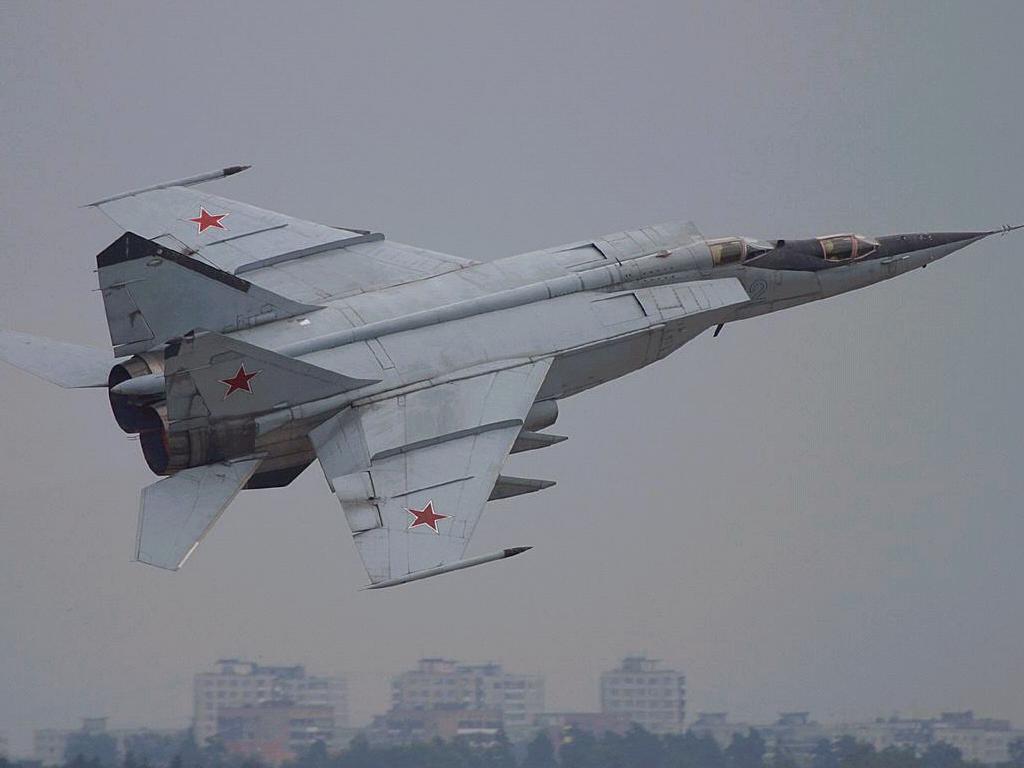
 On May1, 2006, the Indian Air Force bid farewell to one of its most coveted and hush-hush assets – the Mikoyan-Gurevich MiG-25RB “Foxbat”, known in the Air Force as “Garuda”. With the departure of the Foxbat, the Indian Air Force will not only lose its fastest aircraft, but also its premier spyplane – an aircraft that served it very well for over twenty-five years. Indeed, it would be very difficult to find an Air Force officer who disagrees with Wing Commander Sanjeev Taliyan, who once commanded the MiG-25 squadron, when he says, “No aircraft has ever been able to achieve for us what the Foxbat has. We will miss flying them.” Shiv Aroor of the Indian Express has written an excellent article on the topic.
 In the 1950s, the
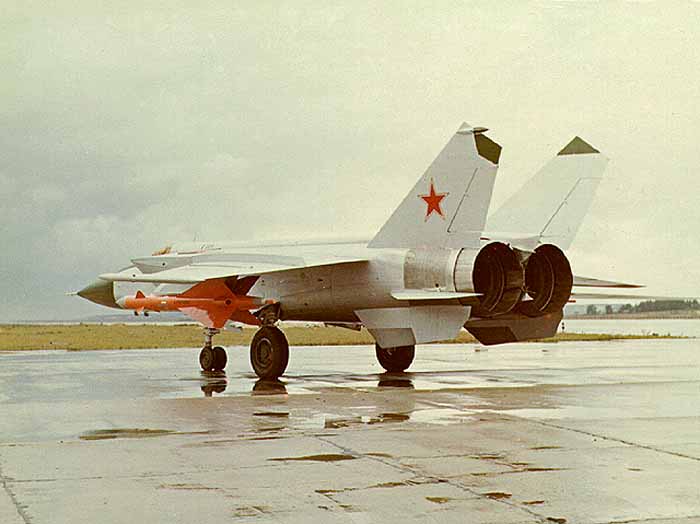 However, the MiG-25 also had some clear virtues from the outset. It was quintessentially a Soviet aircraft, being relatively inexpensive, rugged, reliable, easy to maintain, and straightforward to operate. It was representative of MiG’s philosophy of building world-class fighter aircraft using decade-old technology. The RP-25 “Smerch” 500kW radar could burn through heavy jamming, and had a detection range of 100 kilometres. In fact, pilots were not allowed to engage it on the ground, and it is said that this radar was powerful enough to kill rabbits near the runway. Also, many engineers claim that the much-ridiculed vacuum tube electronics are perfectly practical and cost-effective for high-power microwave applications, and are less susceptible to radiation in case of a nuclear attack.

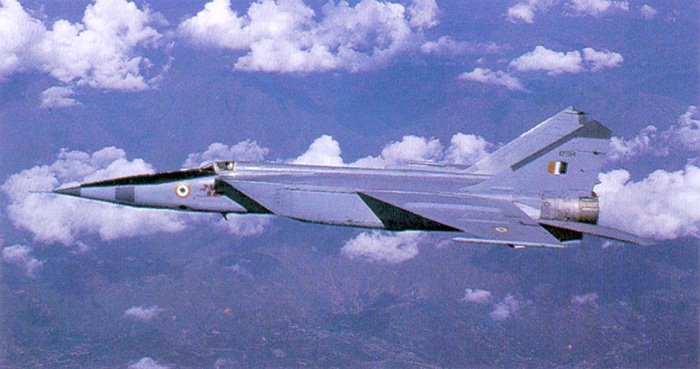 After entering service, the Foxbats have been said to routinely intrude into hostile airspace to spy on enemy facilities. They were used in Operation Pawan (
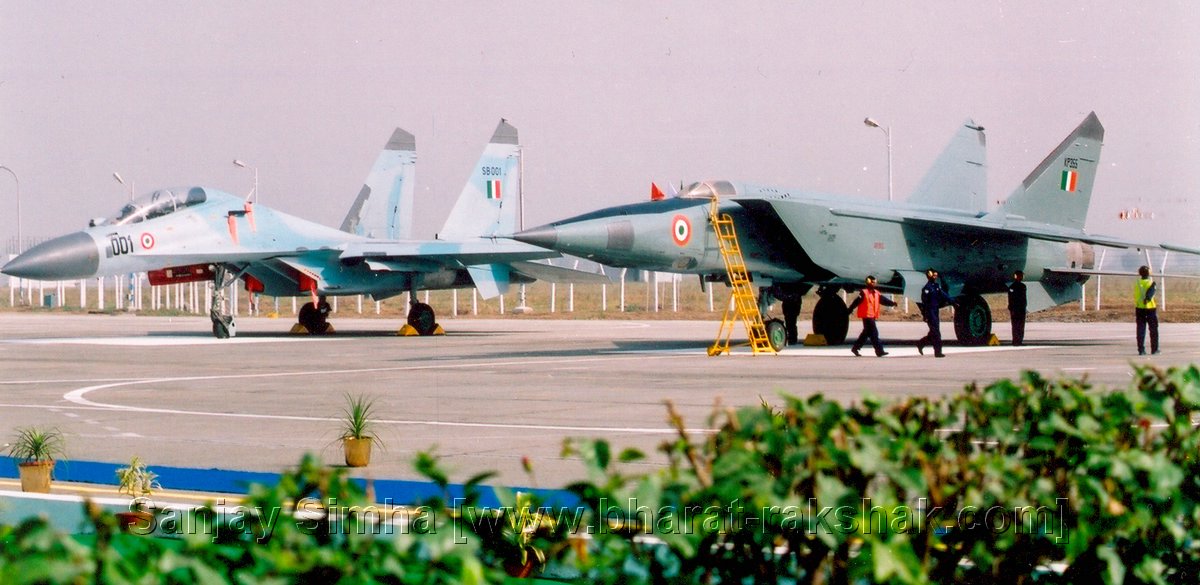 However, there is a limit to which an airframe can be flogged, and as Wing Commander Ashok Chauhan of the Rapiers Squadron puts it, “we can push our Foxbats for another 2-3 years, but after three life extensions, it’s prudent to retire them now”. There is little doubt that the retirement of the MiG-25RB has left a gaping hole in
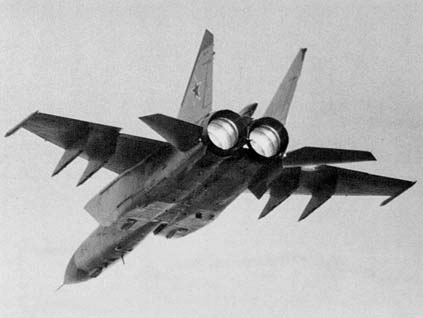
 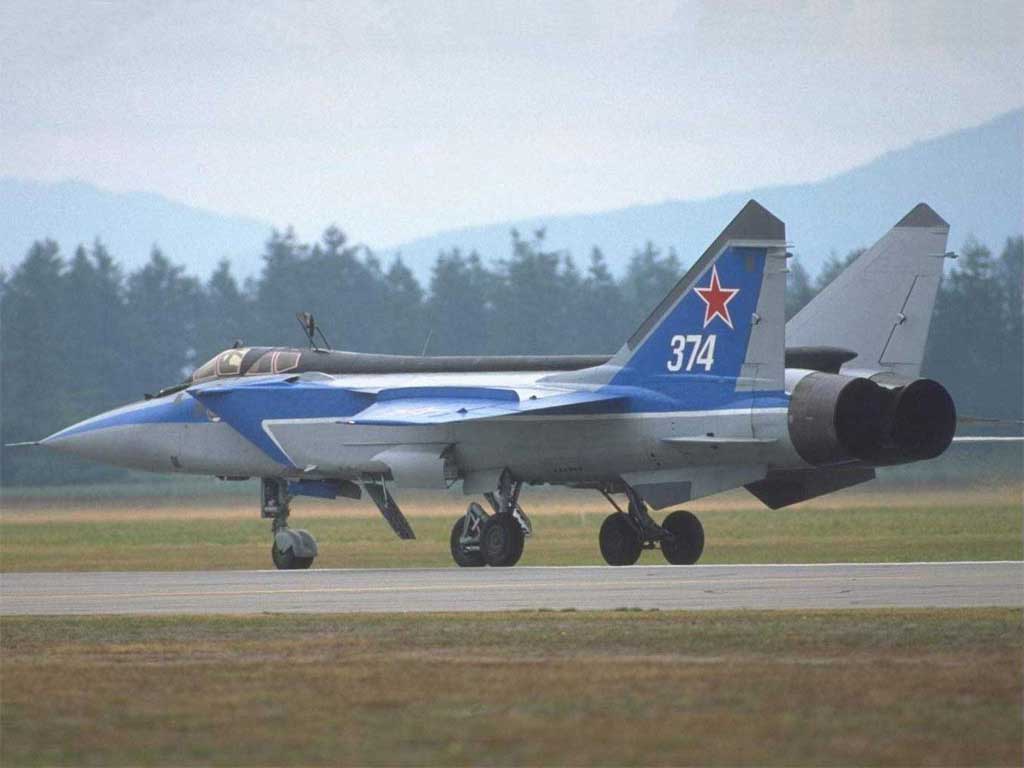 my to hide stuff from them. Also, spy planes can collect air samples from the test sites of nuclear and other weapons - something satellites may never be able to do. There are reports that Russia had offered the MiG-31 “Foxhound” (shown right), a heavily modernised MiG-25 to
On December 8, the 2005 meeting of the Organisation of Islamic Conference came to an end. The purpose of the summit was purportedly to reject extremism, condemn terrorism, extol the virtues of tolerance and stress the importance of the protection of human rights. Frankly, I find this laughable. Let us see why I find the OIC to be such a big joke:
First, let us start with the name of the organisation itself. Organisation of Islamic Conference? What the hell does that mean? Organisation of Islamic Countries, I can understand, but this? It either makes no sense, or my English sucks, although I have a sneaking suspicion that it is the former.
Then, there is the venue – the city of Makkah in Saudi Arabia. As we all know, Makkah is the holiest Muslim city, and non-Muslims are not allowed to enter it. Also, Saudi Arabia itself is the hallmark of intolerance in today’s world. If a man is caught practising a religion other than Islam in Saudi Arabia, he faces certain death. I find it ironic that the organisation that held a summit in a country where there is no religious freedom, and in a city non-Muslims are not allowed to enter, preached tolerance to the world.
Third, the member countries themselves aren’t exactly role models to be followed when it comes to human rights, tolerance, and condemning extremism and terrorism. Here are some of the leading lights:
It is no wonder that the OIC has lost all relevance today has become the laughing stock of the world.
 Before the flight of the Tejas (LCA, for those who choose to keep themselves uninformed) Prototype Vehicle – 2 (PV-2) on 2nd December 2005, quite a few defence enthusiasts, politicians, Air Force officers, and our media had virtually written off the project as a failure. Our newspapers and magazines were full of articles criticizing everyone from the management and the engineers to the sweeper boy. However, the flight of the PV-2 (Shown in the yellow primer in the picture) has proved that the Tejas project is very much alive and progressing at a steady pace. While there is no getting past the fact that the project has suffered from many delays and setbacks, it is far from being the white elephant that many want us to believe. Here, I will try to explain the significance of the LCA project and why it is necessary for the country. But first, some background information.
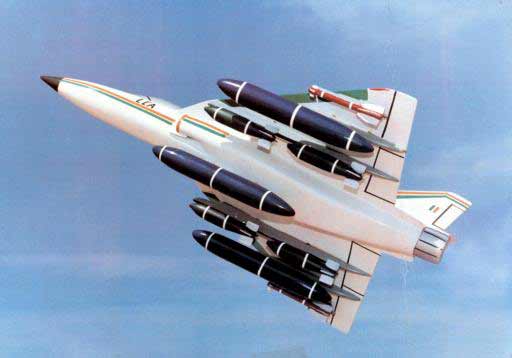 The Tejas is a supersonic multi-role aircraft meant to replace the IAF's frontline MiG-21 fighters. It is, as the name implies, the world’s smallest combat aircraft. It is constructed of aluminium-lithium alloys, carbon-fibre composites, and titanium. The aircraft features relaxed static stability with a full authority digital fly-by-wire system, which ensures excellent manoeuvrability, greater safely, and carefree handling. The delta wing ensures good performance at high altitudes and high speeds, while the radical low-sweep leading edge, optimised camber, and the fly-by-wire system ensure performance at high angles of attack. Other features include Multi-Mode Radar (air to air, air to ground, and air to sea modes), a glass cockpit, a Helmet Mounted target Designator, (HMD) and Hands on Throttle and stick (HOTAS) controls which reduce pilot workload. Powering the Tejas for the foreseeable future will be one General Electric GE F404-IN20 turbofan, while work on the indigenous ‘Kaveri’ GTX-35VS turbofan continues. The Aeronautical Development Agency (ADA) is the main developer, while Hindustan Aeronautics Limited (HAL) and the Defence Research and Development Organisation (DRDO) are major partners.
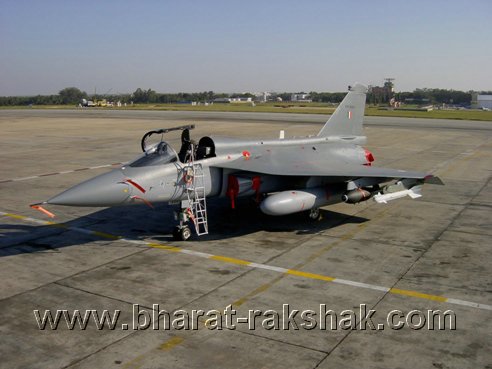 As of now, there are four Tejas in existence, viz. Technology Demonstrators – 1 and 2 (TD-1 and TD-2), and Prototype Vehicles – 1 and 2 (PV-1 and PV-2). The ADA has planned five prototypes (PV-1 to PV-5). PV-5 was originally meant to be a two-seat trainer, but this has now been advanced to PV-4. The Tejas first flew on 4th January 2001. As of Dec 2, 2005, 476 test flights were completed (TD-1: 166, TD-2: 200, PV-1: 109, PV-2: 1). Eventually, the LCA requires to fly 1,000 sorties to establish its Initial Operational Capability (IOC) which implies basic air-to-air and air-to-ground attack capabilities.
 For all its capabilities, the Tejas project has suffered from a number of delays and has been plagued by many serious problems. The biggest of these is the Kaveri engine, which has been under development since 1986 at the Gas Turbine and Research Establishment (GTRE), Bangalore. The engine is too heavy, does not develop sufficient thrust, and there are problems with the fuel management system. While the engine has been sent to Russia for trials, it is unlikely to be seen on the Tejas anytime soon, and the American GE F404 will have to do. The Tejas’ Pulse Doppler Multi-Mode Radar (MMR), which will detect, track, terrain-map and deliver guided Beyond Visual Range (BVR) weapons, had also run into major hitches and, consequently, time and cost overruns. The option of using an off-the-shelf radar like the American AN/APG-67 or the Israeli Elta was being seriously looked at. However, the PV-2 has flown with an Indian MMR, which is a major milestone for Indian aviation. Many of these problems may be attributed to the economic sanctions imposed by the US after of nuclear tests in 1998. The supply of new engines, and the support for those already purchased was stopped. Also, the Flight Control System (FCS), which was being designed with the help of Lockheed Martin ran into major problems. Scientists working at Lockheed Martin were sent back; equipment, software and documents were impounded.
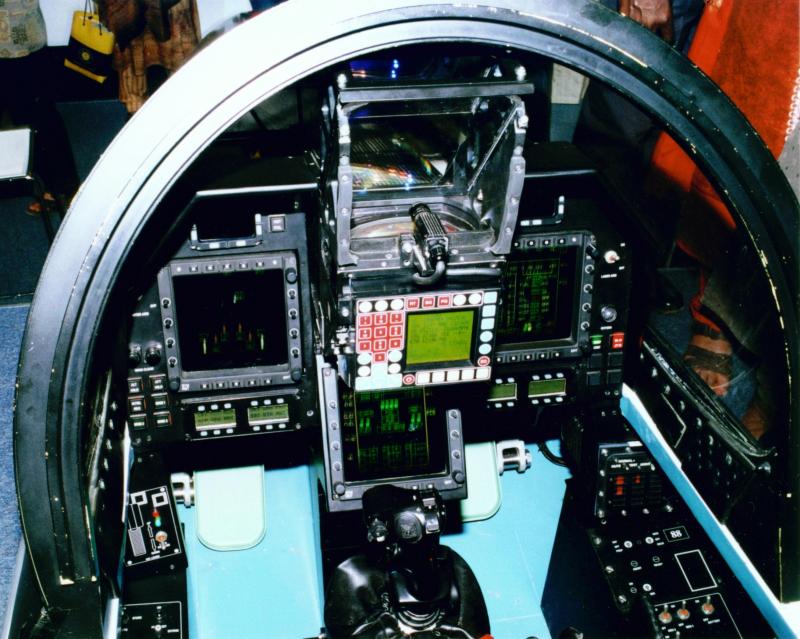 It is these events that have led to the labelling of the Tejas as a ‘dead project’ and a ‘damp squib’. In reality, nothing could be farther from the truth, as the flight of the PV-2 (a production spec aircraft) has proved. A project of this scale has seldom been undertaken by India. Air Marshal MSD Wollen, who was the Chairman of HAL from 1984 to 1988 says, “In the late eighties (and even now) India's aircraft industry was not as advanced as Sweden's, and yet India follows a more arduous design/development route for its Tejas, compared to Sweden for its JAS-39 Gripen. The Gripen makes use of a far higher percentage of off-the-shelf foreign technology, including the RM-12 engine (a license manufactured F404) and the mostly American weapon systems”. Even the Chinese and Japanese projects make use of foreign engines: the Chinese JF-17 ‘Thunder’ uses a Russian Klimov RD-93 turbofan (an upgraded version of the RD-33 found on the MiG-29), while the Japanese F-2, itself an upgrade of the F-16, uses a General Electric F110-GE-129. On the other hand, India is developing its own engines and a few weapon systems (the Astra BVR air-to-air missile being the most significant). Hormuz Mama, in his article on the LCA in ‘Flight International’ wrote, “Combining a new airframe and engine puts development of the Tejas in the same class as the Dassault Rafale and Eurofighter Typhoon, according to ADA. Add to that the requirement to develop a naval variant, and the scale of India's undertaking becomes more evident”. After the US imposed sanctions on India, Indian engineers and scientists designed and built a new quadruple-redundant, digital fly-by-wire flight control system from scratch – and that too in record time. Such a complex system is not the easiest thing in the world to develop, as is evident from the Chinese experience with the JF-17, which uses fly-by-wire only for yaw control (As much as they would hate to admit, developing a full-blown digital fly-by-wire system is simply beyond the capability of the Chinese). Moreover, the Tejas is one of the most structurally advanced aircraft ever built. Consider this: Carbon Fibre Composites used in the fuselage, wings, and tail account for 45% of the structural material used, aluminium alloys account for 43%, and titanium alloys 5%. The extensive use of composites, the small size, and the Y-shaped intake duct that hides the compressor faces make it one of the most (if not THE most) Low Observable (LO) 4th generation aircraft around.
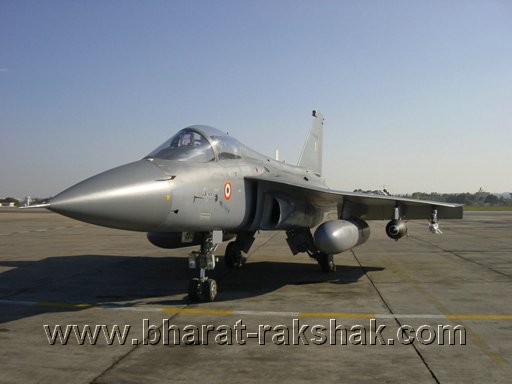 Considering the in-house development of most of the Tejas’ components, the Tejas is, without doubt, one of the most indigenous aircraft around. Moreover, the Tejas program has spawned off some technologies, like the mission computer and the ‘Tarang’ Radar Warning Receiver (RWR) which are being used on many other IAF aircraft including the MiG-27, Jaguar, and Su-30MKI. To cancel the program now might ruin our fledgeling aerospace industry, whose very existence depends on the success of the Tejas and the Dhruv Advanced Light Helicopter. Look at what happened to the Canadian aircraft industry after they cancelled the promising CF-105 ‘Arrow’ interceptor in favour of the Bomarc Missile. As M Natarajan, chief executive of DRDO says, “After spending nearly Rs 10,000 crore between the Tejas and the Kaveri, the only way to go is forward.”
Some good reading material on the LCA:
This Article was written by me and Akshay Raut
“With great power comes great responsibility.” All Spiderman fans are well aware of this statement. This statement is significant when one talks about the nuclear power dynamics of south Asia.
India went nuclear on May 11th, 1998. However, it is popularly believed that India had its first functional tactical fissile device in operational mode since 1976. Pakistan on the other hand, went nuclear in 1998. Since then, the nuclear balance in the subcontinent has been swinging dangerously; primarily due to the lack of any nuclear command and control structure in both the countries. The lack of such strategic control mechanisms gives rise to a potentially volatile, high risk situation in case of any sort of military stand-off between the two countries like the one which happened in December 2001 after Pakistan-backed terrorists stormed the Indian Parliament in New Delhi. Although the use of tactical/strategic nuclear weapons is never even considered in such stand-offs, the preparedness is there. In fact, the preparedness is always there. India has seemed to recognize the problem and there is apparently a nuclear command and control structure is already in place. But this does not solve the problem. There needs to be a well-defined nuclear policy in place, which can be applicable in any sort of scenario. Making public claims of a “no first use policy” does not help.
There is many a lesson to be learnt from the Cold War. Both, the USSR and the USA had stringent measures in place to avoid any accidental firing of missiles, which would trigger off a nuclear war. Spy satellites and radar stations were constantly scanning each other’s missile sites to detect even the minor signs of activity. If there was any “reason to believe” that the other had launched an attack, missiles would be launched immediately to decapitate any second wave of strikes. This mechanism rested on a strong intelligence and communication network. Such networks were specifically designed to cater to the national nuclear command and were completely independent of the other military and civilian networks. The actual order of launching a nuclear strike was at the disposal of the President and his second and third in command. No order could be issued unless everybody concurred, not orally but electronically. So no renegade general or distraught soldier could fire the missile in the country’s name and spark off a chain of mutual annihilation. Although, during the Cold War, America’s nuclear programme was completely and solely aimed at the erstwhile USSR, it matured into a non country-centric system, meaning that it did not aim at any particular country. This happened due to the enormous geographical distance between the two powers.
As opposed to this, India’s programme seems to be wholly and solely aimed at Pakistan or at the most China. This is highly unfavourable in today’s fast changing global political scenario. A foe today could be a friend tomorrow. Hence there is an urgent need on India’s part to make its programme non country-centric. But it has to be done in a less explicit and in a gradual manner. This means that the government should not come out one fine day saying that it has 400 nuclear tipped ICBMs (Inter-Continental Ballistic Missiles) aiming at different parts of the world, as this obviously would seem hostile. There are claims that India sanctioned a programme to develop an ICBM called ‘Surya’ in 1990 and that it might be a variant of ISRO's successful Polar Satellite Launch Vehicle (PSLV). It is alleged that it has a massive range of about 12000 km. If true, then this just about solves India’s problems when it comes to missile-based delivery systems. But India still doesn’t have submarines to launch nuclear missiles from underwater. Silent, mobile, virtually unlimited in range, and with 70% of the world’s surface to prowl in, nuclear-powered ballistic missile submarines (SSBNs) are by far the most powerful launch platforms for nuclear tipped ballistic missiles. Consider this: the massive Soviet/Russian Typhoon-class SSBN is armed with 20 RSM-52 (SS-N-20 "Sturgeon") ballistic missiles with a range of 8,300 km, each carrying up to 10 nuclear warheads. India has been working since 1985 to develop an indigenously constructed nuclear-powered submarine, known as the Advanced Technology Vessel (ATV), one that is based on the Soviet Charlie II-class or Akula II-class design. In January 1988 the Soviets leased a Charlie-I nuclear powered submarine to India, where she served until January 1991 as the “Chakra” and the submarine was manned by a Russian crew training Indian seamen to operate it. Though Indian engineers hoped to reverse-engineer its reactor, the Russians would not let them anywhere near it. Although India has the capability of building the hull and developing or acquiring the necessary sensors, its industry has been stymied by several system integration and fabrication problems in trying to downsize a 190 MW pressurized water reactor (PWR) to fit into the space available within the submarine's hull. Once completed, the ATV will probably be armed with the Sagarika cruise missile (still under development) with a range of 1500-2000 km, or a land attack version of the BrahMos.
If India one day hopes to become a superpower with the ability to project on a global scale, it will have to develop SSBNs and the concomitant nuclear tipped ballistic missiles. Not just that, but it would also need an well-defined nuclear policy capable of dealing with any nuclear scenario, and the political will to carry out nuclear strikes (first strikes, if necessary) to neutralise an enemy before he has the chance to attack. This issue has to be dealt with in a strategically sound manner, because the very existence of the people of this planet is at stake when countries try to play God, the nuclear way.


